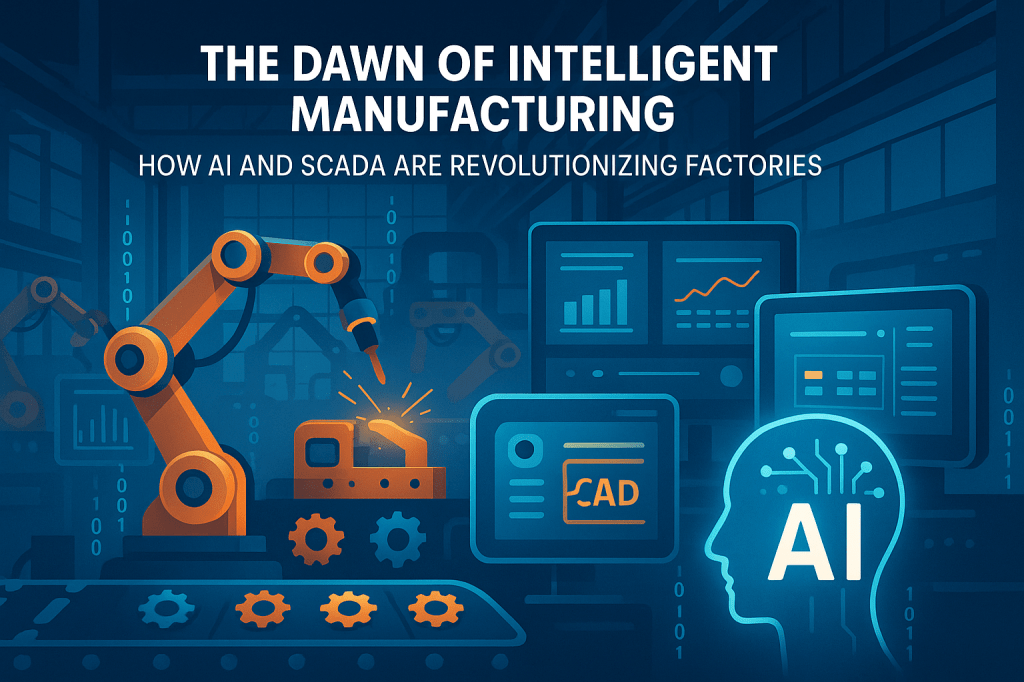
The manufacturing landscape is undergoing a profound transformation, driven by the powerful synergy of Artificial Intelligence (AI) and Machine Learning (ML) with Supervisory Control and Data Acquisition (SCADA) systems. This integration isn’t just an incremental upgrade; it’s a fundamental shift that is redefining operational efficiency, cost reduction, and quality control across industrial plants.
SCADA: The Unsung Hero of Industrial Control
At its core, a SCADA system acts as the central nervous system of an industrial operation. It meticulously monitors and controls processes across diverse sectors, from manufacturing and energy to water management and oil & gas. These systems are designed to collect real-time, high-resolution data from countless field devices like sensors, Programmable Logic Controllers (PLCs), and Remote Terminal Units (RTUs). Through intuitive Human-Machine Interfaces (HMIs), SCADA provides operators with a centralized view of plant activities, generating alarms for deviations and enabling remote control for swift decision-making.
SCADA’s inherent strength lies in its real-time data acquisition and control capabilities, making it the primary, high-fidelity data source for operational technology (OT) environments. It’s not just a control system; it’s the essential data backbone for industrial intelligence.
AI/ML: The Brain Behind the Brawn
While traditional SCADA systems are highly effective for monitoring and control, they are typically rule-based and lack the ability to learn from historical data or predict future events. This is where AI and ML algorithms step in. By analyzing the massive volumes of real-time data collected by SCADA systems, AI/ML can identify complex patterns, foresee potential errors, and even automate remedial actions, significantly enhancing the overall efficiency and dependability of industrial operations.
This integration marks a crucial shift from reactive control to proactive intelligence. Historically, operations would wait for an issue to arise before addressing it. Now, AI’s capability to “find trends, foresee errors, and automatically take remedial action” means that potential problems can be identified and addressed before they escalate into significant failures. This strategic evolution moves manufacturing processes from crisis management to continuous optimization and risk mitigation, leading to substantial improvements in productivity and resilience.
The benefits are extensive: routine tasks are automated, control settings are optimized, and the need for constant human intervention is significantly reduced. Furthermore, AI-powered SCADA systems provide operators with actionable insights derived from complex data analysis, empowering better decision-making across the plant floor.
The sheer volume and immediate availability of SCADA data are indispensable for the effectiveness of AI applications, making the SCADA infrastructure a critical enabler for advanced industrial intelligence. The dawn of intelligent manufacturing is here, and it’s powered by the seamless integration of AI/ML with SCADA.
 Home
Home 
Leave a comment